
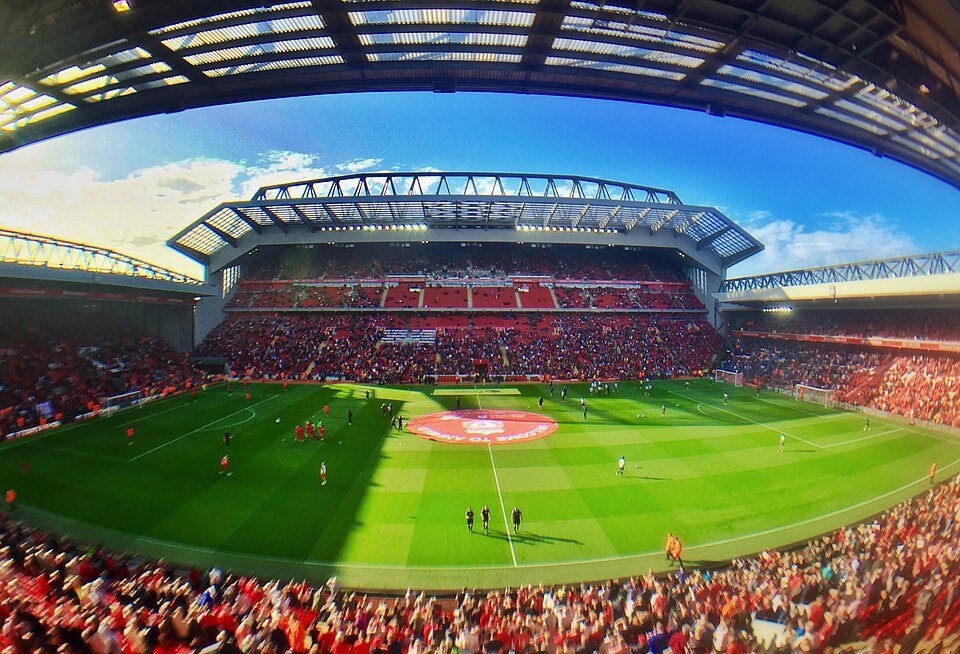
There are bigger stadiums. There are newer stadiums. There are stadiums with better sightlines, more comfortable seats, and Wi-Fi that actually works in the concourse. There is no stadium on earth that sounds like Anfield on a European night. The question of why Anfield is famous has a simple answer wrapped in a complicated history: the Kop, the anthem, and a relationship between a football club and its supporters that has survived tragedy, triumph, and everything in between.
The Kop: A Stand With a Battlefield Name
The Spion Kop is the most famous single stand in world football. Its name comes from a hill in South Africa where British soldiers — including many from Liverpool — fought and died during the Boer War in 1900. When Liverpool built a large earth banking behind one of the goals at Anfield in 1906, the local press nicknamed it the Kop, and the name stuck. By the 1960s, the standing Kop held 28,000 supporters — a swaying, singing mass of humanity that Bill Shankly called “the most important player Liverpool ever had.”
The standing Kop was demolished in 1994 following the Taylor Report, replaced by an all-seater stand holding 12,000. Supporters feared the atmosphere would die with the terraces. They were wrong. The new Kop transferred the spirit of the old one into a structure that was safer but no less passionate. On April 30, 1994, the final match in front of the standing Kop — a 1-0 defeat to Norwich — was described by BBC commentator John Motson as “a carnival atmosphere,” with legends from Billy Liddell to Kenny Dalglish paraded on the pitch and a banner reading “The Kop Spirit Survives” unfurled across the stand. Thirty years later, that claim has been proven correct.
You’ll Never Walk Alone
Gerry and the Pacemakers released their cover of “You’ll Never Walk Alone” in 1963. Liverpool fans adopted it as their anthem shortly after, and no song in world football carries more emotional weight. Before Champions League nights, the PA system plays the recorded version while 54,000 people hold scarves aloft and sing every word. The visiting players stand in the tunnel listening to it. The television cameras linger on the Kop. The moment before the final chorus — when the music drops and the crowd carries the melody alone — is the closest football gets to a religious experience.
Celtic fans sing it too, and Borussia Dortmund supporters have their own version, but “You’ll Never Walk Alone” belongs to Anfield the way “Sunshine of Your Love” belongs to the electric guitar. It is inseparable from the place.
European Nights: The Anfield Factor
Anfield under floodlights on a Champions League night behaves differently than Anfield on a Saturday afternoon. The noise is louder. The tempo of the match is faster. Visiting teams who have dominated at bigger, more modern stadiums have arrived at Anfield and fallen apart. Barcelona learned this in 2019. The 4-0 comeback — Divock Origi’s quickly taken corner, Trent Alexander-Arnold’s genius, Georginio Wijnaldum’s two goals in two minutes — was not just a football result. It was Anfield doing what Anfield does: making the impossible feel inevitable.
The “This Is Anfield” sign in the players’ tunnel, installed by Bill Shankly in 1962, serves a dual purpose. It reminds Liverpool players of the privilege they carry. It reminds opponents of the ordeal they are about to face. The sign is a piece of metal with white lettering on red. Its power is entirely psychological — and entirely real.
Anfield is famous because football happens differently there. The Kop sings, the stadium breathes, and for 90 minutes, everything outside the ground ceases to exist. That is not marketing copy. That is what 130 years of history, six European Cups, and a fanbase that treats the club as an extension of its identity sounds like when it reaches full voice.
Sources: ThisIsAnfield.com “The Kop’s last stand — 30 years since Anfield’s carnival atmosphere farewell” (April 2024); FutbolFocus.com “Anfield: Liverpool’s Fortress and Its Unique Atmosphere” (2026); IL-LFC.net “The Story Behind Anfield’s Atmosphere” (2026).